


Why is ultrasound the first test?
Ultrasound is the best imaging test for finding gallstones. Cholesterol stones, the most common type, are usually not visible on a CT scan but do show up on ultrasound. A CT scan can miss gallstones that are there.
The test uses high-frequency sound waves that a computer turns into images. Unlike X-rays or CT, it does not expose you to ionizing radiation.
How should you prepare?
- Fasting. You will likely be asked not to eat or drink for several hours before the test. The exact preparation depends on why the test was ordered and is explained by whoever requests it.
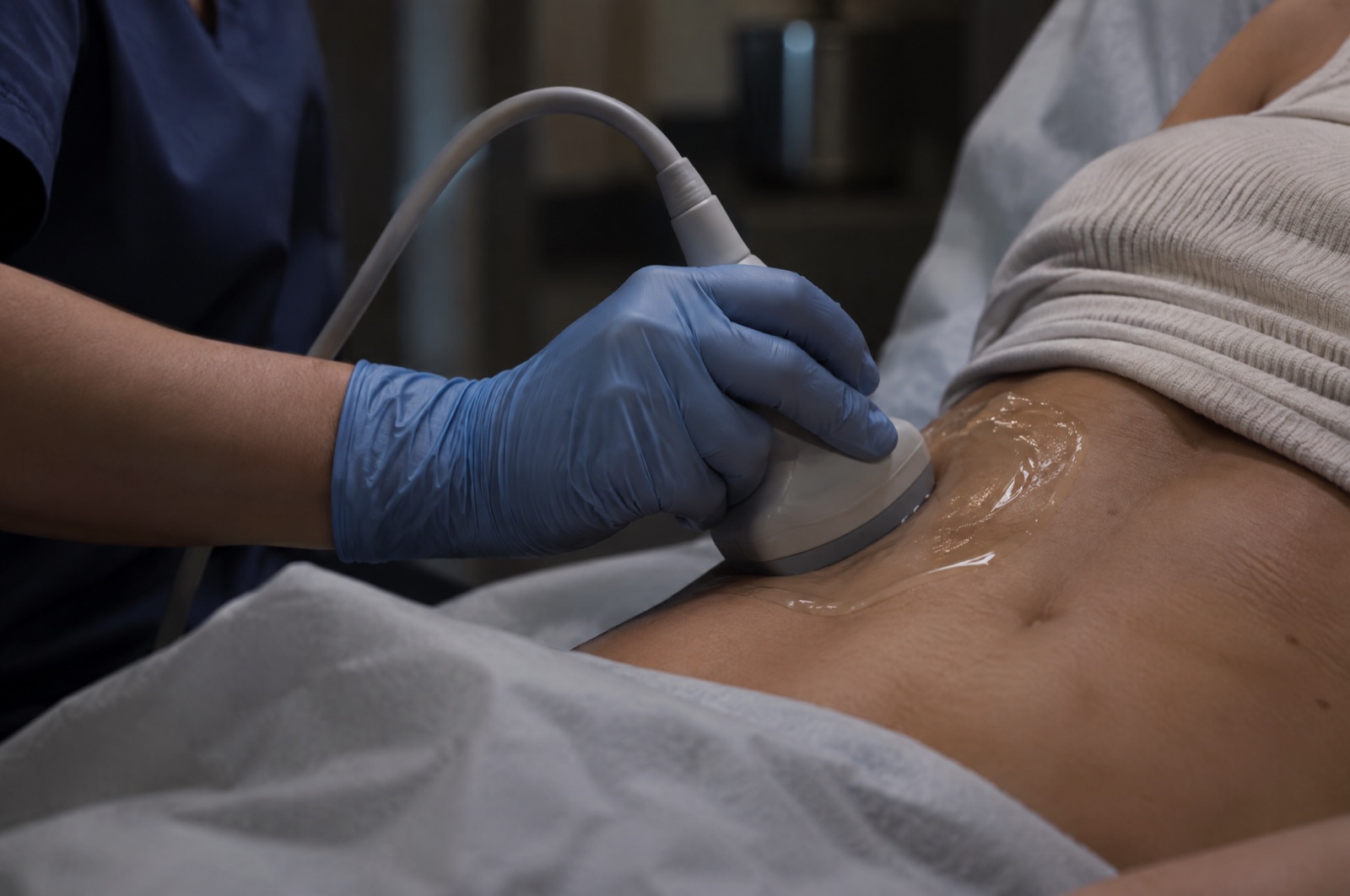
- During the test. You lie down; a gel is applied to your abdomen and a handheld transducer is moved over it. You may be asked to change position or briefly hold your breath.
- Discomfort. There is little: the gel feels cool and the probe may press a bit. Most of the time it takes under 30 minutes.
- Risks. There is no known risk.
What can the report show?
The report describes whether there are stones, signs of gallbladder inflammation (cholecystitis), blocked bile ducts, or other findings in the liver, pancreas or kidneys. It is also the first test when a growth attached to the gallbladder wall is seen; those follow their own rules, covered in the guide on gallbladder polyps.
A finding alone is not a reason for surgery. The result is read together with your symptoms and the exam; stones that do not hurt are not always removed (gallstones without symptoms).
When are other tests needed?
- Blood tests. Bilirubin, liver function tests, a complete blood count and pancreatic enzymes (amylase or lipase) show infection, inflammation or blockage.
- Suspected bile duct stone. European endoscopy guidelines recommend starting with liver function tests and ultrasound; if suspicion persists and ultrasound is not enough, endoscopic ultrasound or MRCP is used.
- HIDA scan. Used to look for abnormal gallbladder contractions or a blocked duct.
- ERCP. It is more invasive and used selectively, mainly to remove a stone stuck in the common bile duct (bile duct stones).
What should you do with the result?
Bring the report and, if you have them, the images to the consultation, along with any earlier studies. At office 501, Tower B, Hospital Galenia in Cancún, the assessment and the operation are done by the same surgeon, Dr. Elinor Vázquez, who sees patients in Spanish and English.
If fever, yellow skin or eyes, or pain that will not ease appear while you wait, do not wait for the appointment: go to the emergency department at Hospital Galenia (switchboard 998 891 5200) or call 911.
This guide is for orientation. It does not replace a consultation.
Frequently asked questions
Do I need to fast before a gallbladder ultrasound?
Usually yes: you will likely be asked not to eat or drink for several hours beforehand. Follow the specific instructions you are given when the test is ordered.
Does the ultrasound hurt or carry risks?
There is little discomfort: the gel feels cool and the probe presses a little. It uses no ionizing radiation and has no known risks.
Is a CT scan better for seeing gallstones?
Not for that purpose. Ultrasound is the best test for finding gallstones; a CT scan can miss them, especially cholesterol stones.
What if the ultrasound is normal but the pain continues?
It is assessed at the consultation. Depending on what is suspected, the scan may be repeated or other tests ordered, such as blood work, endoscopic ultrasound or MRCP.
Sources
- Abdominal ultrasound
- Diagnosis of Gallstones
- Gallstones
- Endoscopic management of common bile duct stones: European Society of Gastrointestinal Endoscopy (ESGE) guideline
- Management and follow-up of gallbladder polyps: updated joint guidelines between the ESGAR, EAES, EFISDS and ESGE
This guide is for orientation and does not replace a medical consultation. In an emergency, call 911.