


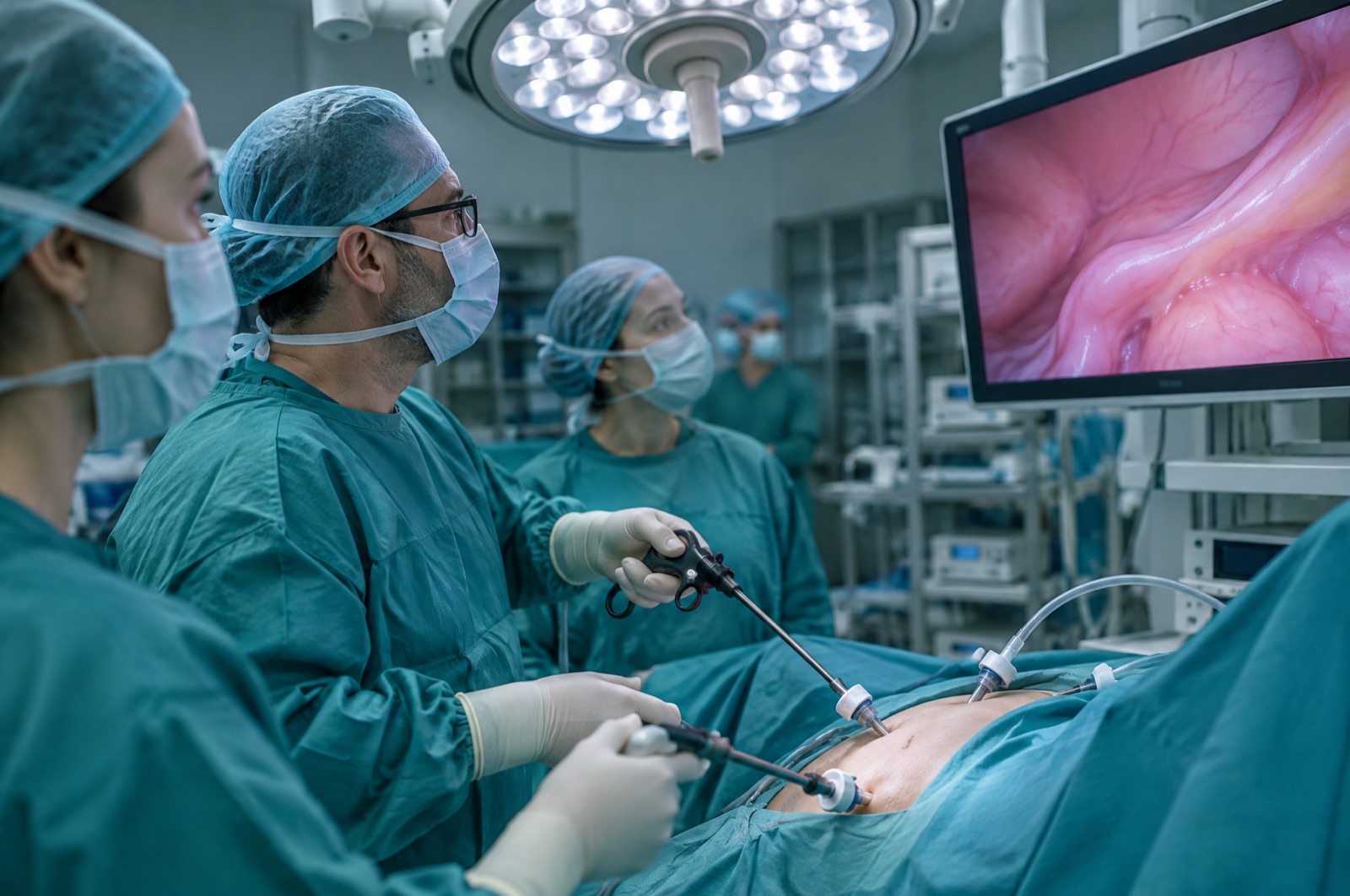
What happens before you go into the operating room?
You arrive having fasted, following the instructions on when to stop eating and drinking, so your stomach is empty. Before the operation, the team asks a few questions and does routine checks. The surgery is done under general anesthesia: you are asleep and feel no pain (NHS and MedlinePlus).
Admission details are in the day of surgery and fasting before surgery.
How is the operation done, step by step?
- Incisions: a few small cuts are made in the abdomen; MedlinePlus says 3 to 4. At Dr. Vázquez's practice it is done through three incisions of about one centimeter when the case allows.
- Working space: gas is pumped into the abdomen to lift the wall and give room to see and work.
- Camera: the laparoscope, a thin lighted tube with a camera that shows the inside on a screen, goes through one incision; the instruments go through the others.
- Identifying and dividing: the structures leading to the gallbladder are separated, closed with clips and cut.
- Removal: the gallbladder is removed with the instruments passed through the incisions.
- Closing: the gas is let out, the incisions are closed with stitches and covered with a dressing.
If there is doubt about stones in the bile duct, an x-ray with dye called a cholangiogram may be taken during surgery (MedlinePlus).
Why is identifying the ducts the most careful step?
Bile duct injury is the most common serious complication of laparoscopic cholecystectomy, according to the 2020 multi-society safe cholecystectomy guideline. To prevent it, SAGES recommends the critical view of safety: clearing fat and tissue from the triangle between the cystic duct, the hepatic duct and the edge of the liver, freeing the lower third of the gallbladder, and confirming that only two structures, the cystic duct and the cystic artery, enter the gallbladder.
SAGES also suggests a brief pause to confirm this before cutting any duct, and using a cholangiogram or other bile duct imaging when the anatomy is unclear; the 2020 guideline makes that a strong recommendation.
What if it cannot be finished laparoscopically?
Sometimes the gallbladder cannot be removed safely by laparoscopy, for example when it is very inflamed; the surgeon then switches to open surgery with a larger cut (MedlinePlus and NHS). SAGES advises stopping the dissection when it approaches a zone of risk and finishing the operation by a safe method, which may be a subtotal cholecystectomy or conversion to open surgery.
Converting is not a failure: it is a safety decision. More in laparoscopic or open surgery.
What happens afterward?
You go to the recovery room until fully awake, with pain medicine if needed (NHS). MedlinePlus says you can go home once you drink liquids easily and pain is controlled with pills; most people leave the same day or the next, and getting your usual energy back can take up to a week. NIDDK notes that many laparoscopic cholecystectomies are outpatient procedures and that normal physical activity usually resumes in about a week.
For shoulder pain from the gas, see shoulder pain after laparoscopy. Care for the following days is in recovery after gallbladder surgery. If you develop fever, bleeding or severe pain, get in touch right away or go to the emergency department.
This guide is for orientation. It does not replace a consultation.
Frequently asked questions
How long does a laparoscopic cholecystectomy take?
The NHS says it usually takes about an hour.
Will I be awake during surgery?
No. It is done under general anesthesia, so you will be asleep and pain-free throughout the operation.
How is the gallbladder taken out?
With instruments passed through the small incisions. A larger cut is only needed if the operation is converted to open surgery.
When can I go home?
Once you can drink liquids easily and pain is controlled with pills. According to MedlinePlus, most people go home the same day or the next.
Sources
- Laparoscopic gallbladder removal
- How gallbladder removal is done
- Treatment for Gallstones
- The SAGES Safe Cholecystectomy Program: Strategies for Minimizing Bile Duct Injuries
- Safe cholecystectomy multi-society practice guideline and state-of-the-art consensus conference on prevention of bile duct injury during cholecystectomy
This guide is for orientation and does not replace a medical consultation. In an emergency, call 911.