


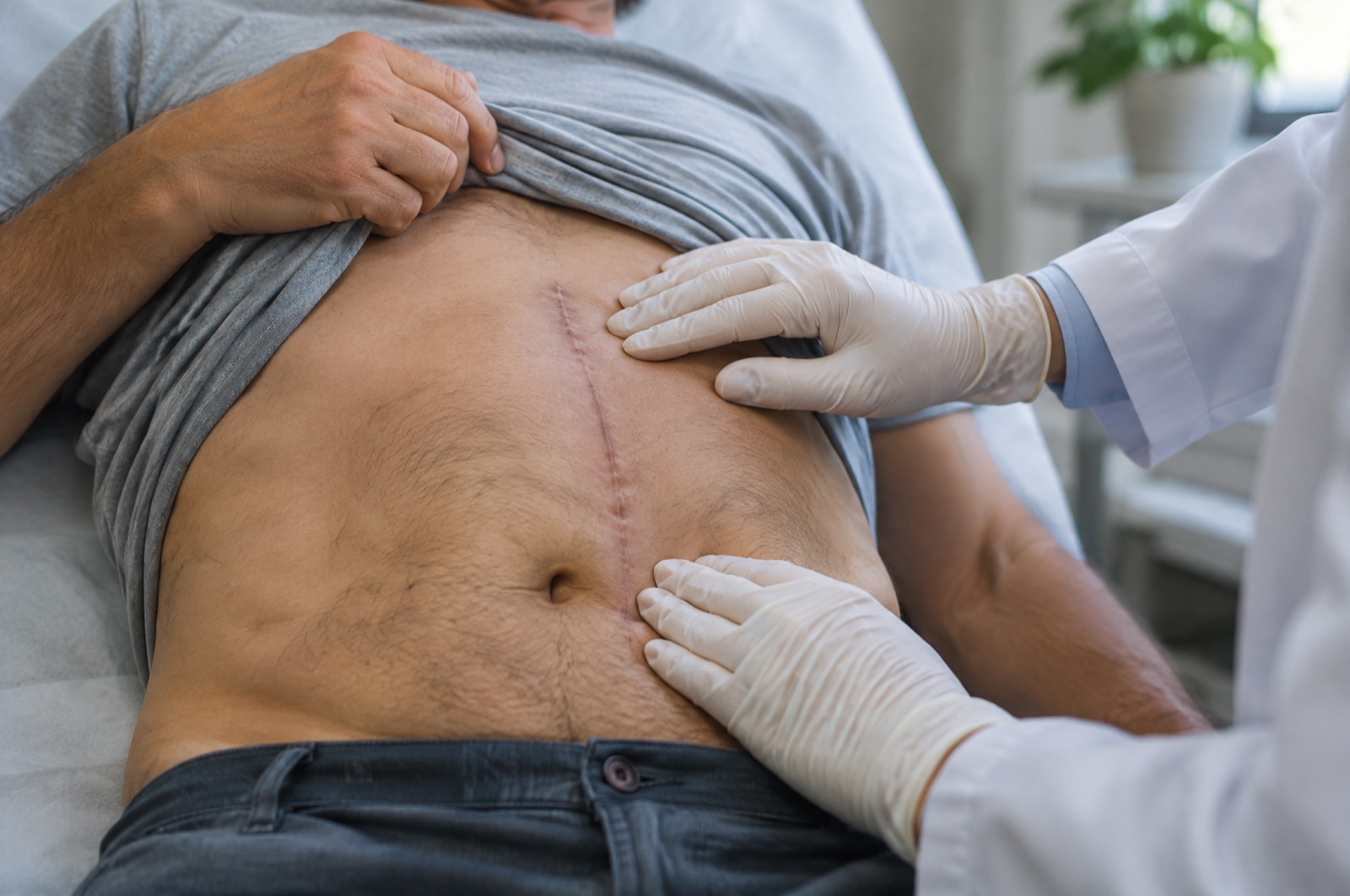
What is an incisional hernia?
After an abdominal operation, the cut in the fascia heals into a scar. If that scar gives way, the abdominal contents push through the weak point and a bulge appears over or beside the scar. MedlinePlus describes it as a type of ventral hernia that usually appears where a previous incision was made.
It can be reducible, if it goes back when you lie down or press gently, or incarcerated, if it no longer goes back. It tends to grow over time, and there may be more than one. It is usually diagnosed by examination; if that is inconclusive, the 2023 European guideline suggests imaging, with CT being the most sensitive test.
Who is more likely to develop one?
The European Hernia Society guideline (2023) lists a high body mass index, smoking, diabetes and immunosuppression as risk factors. MedlinePlus adds a large abdominal incision, persistent coughing, straining on the toilet, heavy lifting and pregnancy.
Does it always need surgery?
Not always straight away. When the hernia goes back on its own, the risk of an acute complication (strangulation or bowel obstruction) is low: about 1% in the first year and 2.5% at 5 years, according to the European guideline. The same guideline suggests surgery when symptoms affect quality of life and the person is fit for an operation, after a careful discussion of the risks and benefits of operating or watching.
The decision is made at the assessment, taking into account size, symptoms, previous operations and general health.
How do you prepare your body before surgery?
The European guideline recommends preparing patients before a planned repair. The three most important modifiable factors are:
- Smoking: the evidence reviewed in the guideline suggests stopping more than 4 weeks before surgery. A 2017 US expert consensus did not recommend planned repair in current smokers.
- Weight: if body mass index is high, weight loss is advised, because complications rise with each obesity class.
- Blood sugar: people with diabetes aim for good control, measured with glycated haemoglobin (HbA1c). The same consensus agreed that complications increase with an HbA1c of 6.5% or higher.
A 2022 European Hernia Society review found that stopping smoking and, for people with obesity, losing weight reduce complications after abdominal wall reconstruction, although the evidence is still limited. If someone cannot lose weight after a dedicated program, the guideline warns that delaying surgery too long also has risks: quality of life worsens and the defect can grow. That decision is discussed at the consultation.
How is it repaired?
For midline incisional hernias, the European guideline recommends a repair with mesh. The approach can be laparoscopic, robotic or open, depending on the patient, the hernia and the team's expertise. MedlinePlus notes that incisional hernias are more likely to come back than other types, which is why mesh and preparation matter.
After surgery, the guideline advises moving about actively from the start, avoiding heavy lifting or exercises that make you strain for 4 weeks and, if it feels more comfortable, wearing an abdominal binder for the first 6 weeks. More in exercise after hernia surgery.
When should you go to the emergency department?
If the bulge no longer gets smaller when you lie down and cannot be eased back, hurts, changes color, or you develop nausea and vomiting, it may be trapped. That is a medical emergency.
If that happens, go to the emergency department at Hospital Galenia (switchboard 998 891 5200) or call 911. Do not wait for an appointment.
This guide is for orientation. It does not replace a consultation.
Frequently asked questions
Is an incisional hernia the same as a ventral hernia?
An incisional hernia is a type of ventral hernia: the one that comes through the scar of a previous abdominal operation.
Why am I asked to stop smoking before surgery?
Smoking is linked to more wound and repair complications. The 2023 European guideline recommends stopping before surgery, and the evidence it reviews suggests doing so more than 4 weeks in advance.
How does diabetes affect the operation?
Poorly controlled diabetes is a modifiable risk factor. Before a planned repair, the aim is good control, measured with glycated haemoglobin (HbA1c).
Can it come back after surgery?
It can. Incisional hernias recur more often than other types, which is why guidelines recommend repairing them with mesh and preparing the patient beforehand.
Sources
- Ventral hernia repair
- Hernia
- Midline incisional hernia guidelines: the European Hernia Society
- Ventral Hernia Management: Expert Consensus Guided by Systematic Review
- The European Hernia Society Prehabilitation Project: a systematic review of patient prehabilitation prior to ventral hernia surgery
This guide is for orientation and does not replace a medical consultation. In an emergency, call 911.