


What is a hernia, and why does it show as a lump?
The abdominal wall has a strong layer called the fascia. When it has a hole or a weak area, the inner lining of the abdomen forms a sac that pushes outward, sometimes carrying fat or a loop of bowel. That is the hernia.
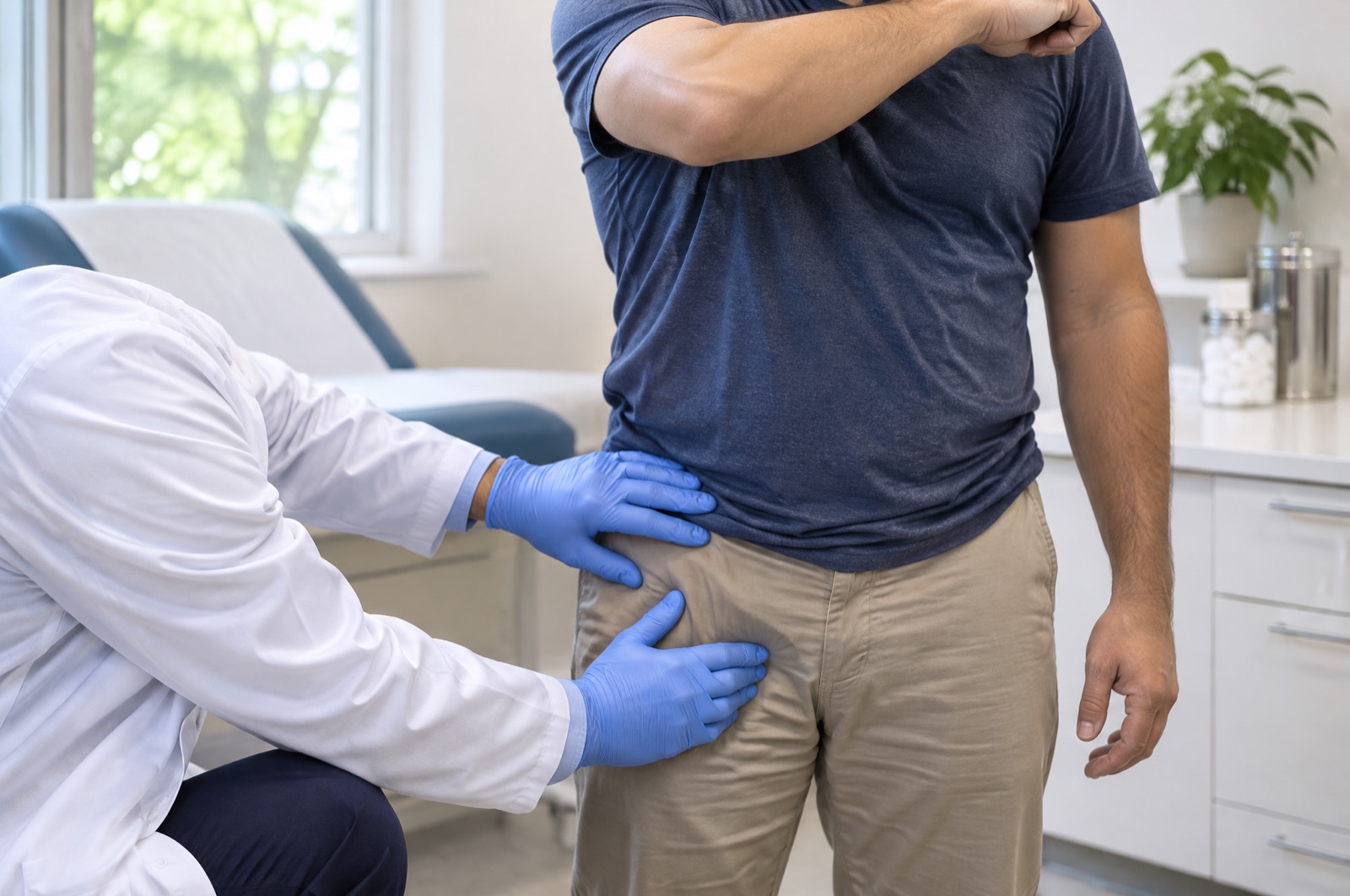
That is why the lump tends to grow when you stand, cough or strain, and shrink when you lie down. Many hernias are only visible; others ache or feel heavy. A physical examination is usually enough to diagnose one; if there is doubt, an ultrasound or CT scan is requested.
How do the five most common types differ?
- Inguinal: a lump in the groin. More common in men, and it can extend into the scrotum.
- Femoral: a lump at the top of the thigh, just below the groin crease. More common in women.
- Umbilical: the defect is in the ring of the belly button.
- Epigastric: the defect is in the midline, above the belly button and below the breastbone.
- Incisional: it comes through the scar of a previous abdominal operation.
Telling an inguinal hernia from a femoral one by examination is not always easy, especially in women; the HerniaSurge international guideline says so explicitly. A groin lump is not classified remotely: it is examined.
Which can be watched and which should be repaired?
They are not all handled the same way. What the guidelines say, in short:
- Inguinal hernia in men with no or minimal symptoms: it can be watched, because the risk of an emergency is low, although most people eventually need surgery (HerniaSurge, 2018).
- Femoral: it strangulates more often than an inguinal hernia; guidelines advise against waiting, especially in women.
- Umbilical and epigastric: without symptoms they can be watched; with symptoms, repair is recommended (EHS/AHS, 2020).
- Incisional: if it goes back on its own, the risk of an acute complication is low, about 1% in the first year and 2.5% at 5 years; surgery is suggested when symptoms affect quality of life (European Hernia Society, 2023).
When surgery is indicated, the timing is chosen at the consultation, based on symptoms, size, general health and how active each person is.
How are they repaired?
Current guidelines recommend reinforcing the repair with mesh for most adult hernias: in the groin (HerniaSurge), at the belly button and midline (EHS/AHS), and for incisional hernias (European Hernia Society). It can be placed through open surgery or laparoscopy, depending on the hernia and the patient.
For inguinal hernias, the site explains how the choice between laparoscopic and open repair is made. For the others, the approach is explained at the assessment.
When is a hernia an emergency?
When the lump turns hard and painful, no longer goes back when you lie down, and you develop nausea, vomiting or cannot pass gas, the contents may be trapped and losing their blood supply. That is called strangulation and needs surgery straight away. More in a hernia that will not go back.
If that happens, go to the emergency department at Hospital Galenia (switchboard 998 891 5200) or call 911. Do not wait for an appointment.
This guide is for orientation. It does not replace a consultation.
Frequently asked questions
Can a hernia go away on its own in an adult?
No. Surgery is the only treatment that permanently repairs a hernia, and many get bigger over time. What the assessment decides is whether to operate soon or keep watching.
Do I need an ultrasound to know which type of hernia I have?
A physical examination is usually enough. If the diagnosis is unclear, an ultrasound or CT scan is requested.
Is a hiatus hernia the same kind?
No. A hiatus hernia happens at the diaphragm, inside the body, and does not show as a lump. This guide covers hernias of the abdominal wall.
Which hernia is most likely to cause complications?
Femoral hernias strangulate more often than inguinal ones, which is why guidelines recommend repairing them. Any hernia that is hard, painful and will not go back is an emergency.
Sources
- Hernia
- Hernia
- International guidelines for groin hernia management (HerniaSurge)
- Guidelines for treatment of umbilical and epigastric hernias from the European Hernia Society and Americas Hernia Society
- Midline incisional hernia guidelines: the European Hernia Society
- Groin hernia and you
This guide is for orientation and does not replace a medical consultation. In an emergency, call 911.