


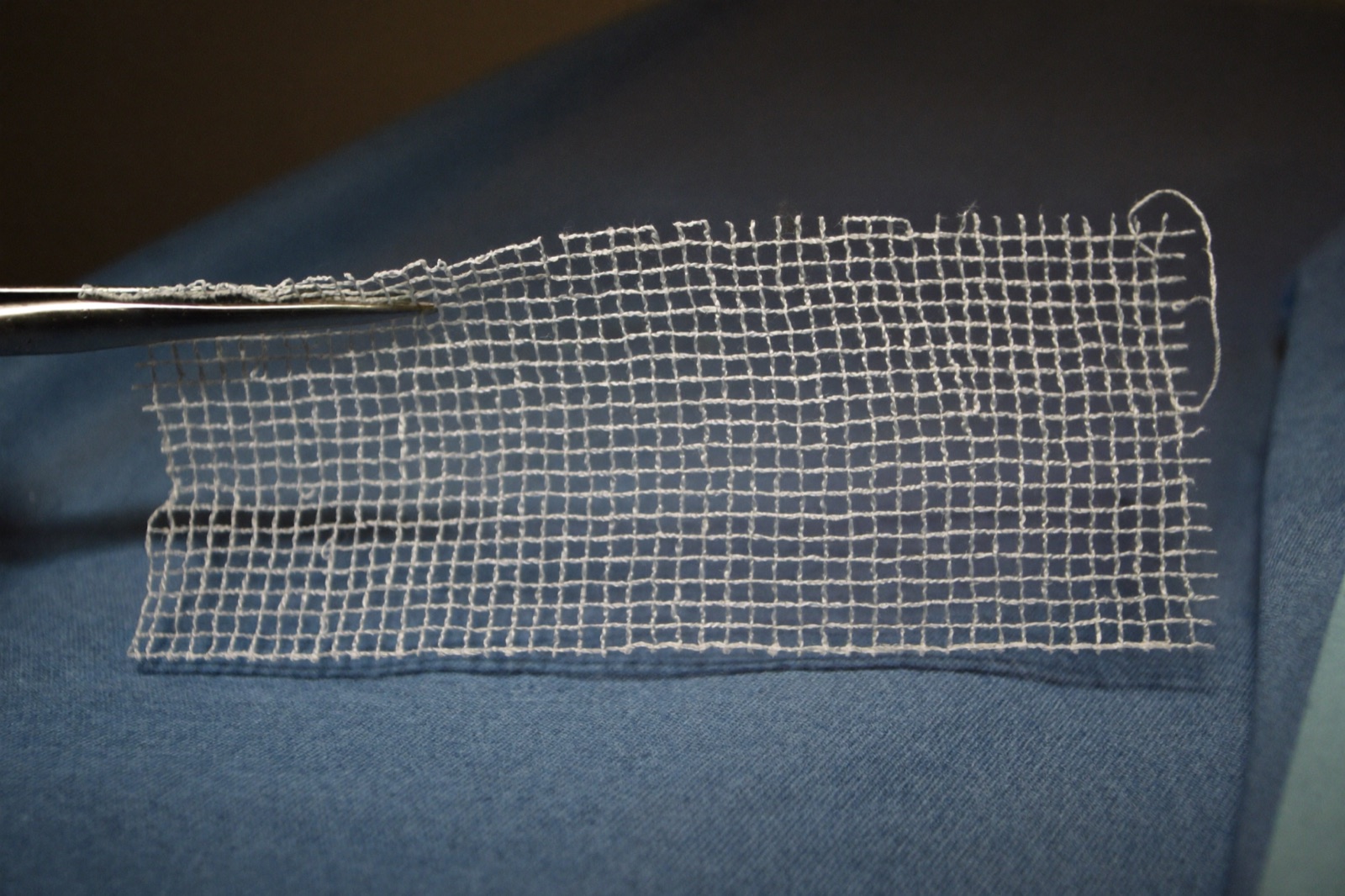
What is mesh, and what is it made of?
According to the US FDA, surgical mesh is a medical device that gives extra support to weakened tissue. It can be made of synthetic materials, knitted or in sheets, or of processed animal tissue, usually from pigs or cows.
- Non-absorbable: it stays in the body indefinitely and gives permanent reinforcement.
- Absorbable: the body absorbs it and it loses strength over time; the idea is that new tissue takes over.
The British Hernia Society compares it to scaffolding: your own tissue grows through it and strengthens the weak area without pulling the edges tight.
Why use mesh instead of stitches alone?
The FDA notes that the medical literature has consistently shown fewer recurrences when mesh is used. The British Hernia Society explains why: many people with a hernia have tissue that does not hold stitches well, and stitch-only repairs fail more often.
That is why the HerniaSurge guideline (2018) recommends mesh as the first choice for groin hernias, by open or laparoscopic surgery; the EHS/AHS guidelines (2020) recommend it for umbilical and epigastric hernias, and the European Hernia Society (2023) for incisional hernias. Even so, the FDA points out that there are situations where mesh may not be recommended and that each case should be discussed with the surgeon; it notes that stitch-only closure is commonly used for small, strangulated or infected hernias.
What complications can happen?
The FDA lists the most common complications of any hernia repair, with or without mesh: pain, infection, the hernia coming back, adhesions, bowel obstruction, bleeding, fistula, fluid build-up (seroma) and perforation. With mesh, migration or shrinkage of the mesh itself can also occur.
- Mesh infection: uncommon; the British Hernia Society puts it at about 1 in 500 groin repairs. If it happens, the mesh usually has to be removed in another operation.
- Pain lasting more than three months: together with recurrence, one of the most frequent problems after groin hernia repair, according to HerniaSurge. Figures vary with the definition: the British Hernia Society mentions up to 1 in 20 repairs, and the HerniaSurge guideline puts clinically significant pain at around 10–12%, decreasing over time. There is no firm link between mesh and that pain; it also happens after repairs without mesh.
What should you ask before surgery?
The FDA suggests bringing these questions to the consultation:
- What type of hernia do I have, and what are the options, with and without surgery?
- Will mesh be used? What is it made of?
- In my case, could it be repaired without mesh? With what risks and benefits?
- What is the risk of recurrence, pain or infection?
After surgery, the FDA recommends keeping a record of the mesh manufacturer, brand and material, which you can request from the hospital where you were operated on. More ideas in what to ask before surgery.
What if something does not feel right afterwards?
A hernia can come back even when mesh was used, and the FDA advises knowing the symptoms so you can be seen in time. Contact the office if you develop a fever, increasing pain, redness, warmth or discharge from the wound. Severe pain with a hard lump that will not go back, vomiting or shortness of breath is an emergency.
If that happens, go to the emergency department at Hospital Galenia (switchboard 998 891 5200) or call 911. Do not wait for an appointment.
This guide is for orientation. It does not replace a consultation.
Frequently asked questions
Can the body reject the mesh?
Mesh is foreign material, like other implants, and it can become infected, although this is uncommon. If it happens, it is usually removed in another operation.
Can a hernia be repaired without mesh?
Yes, in some cases: the FDA mentions stitch-only closure for small, strangulated or infected hernias, and the umbilical hernia guideline allows it for defects under 1 cm. For most adult hernias, guidelines prefer mesh.
Does mesh stop me from having an MRI or CT scan?
The FDA does not present it as a barrier; it advises keeping the mesh brand and material at hand and mentioning it before imaging such as X-rays, MRI or CT.
Does mesh stay in forever?
It depends on the type. Non-absorbable mesh stays indefinitely and gives permanent reinforcement; absorbable mesh is broken down over time.
Sources
- Surgical Mesh Used for Hernia Repair
- Surgical Mesh Used for Hernia Repair: Information for Patients
- International guidelines for groin hernia management (HerniaSurge)
- Mesh and your Hernia Repair
- Groin hernia and you
- Guidelines for treatment of umbilical and epigastric hernias from the European Hernia Society and Americas Hernia Society
This guide is for orientation and does not replace a medical consultation. In an emergency, call 911.